
Flight Lessons for College Students in Philadelphia
Isaac Prestwich, CFII · November 10, 2026
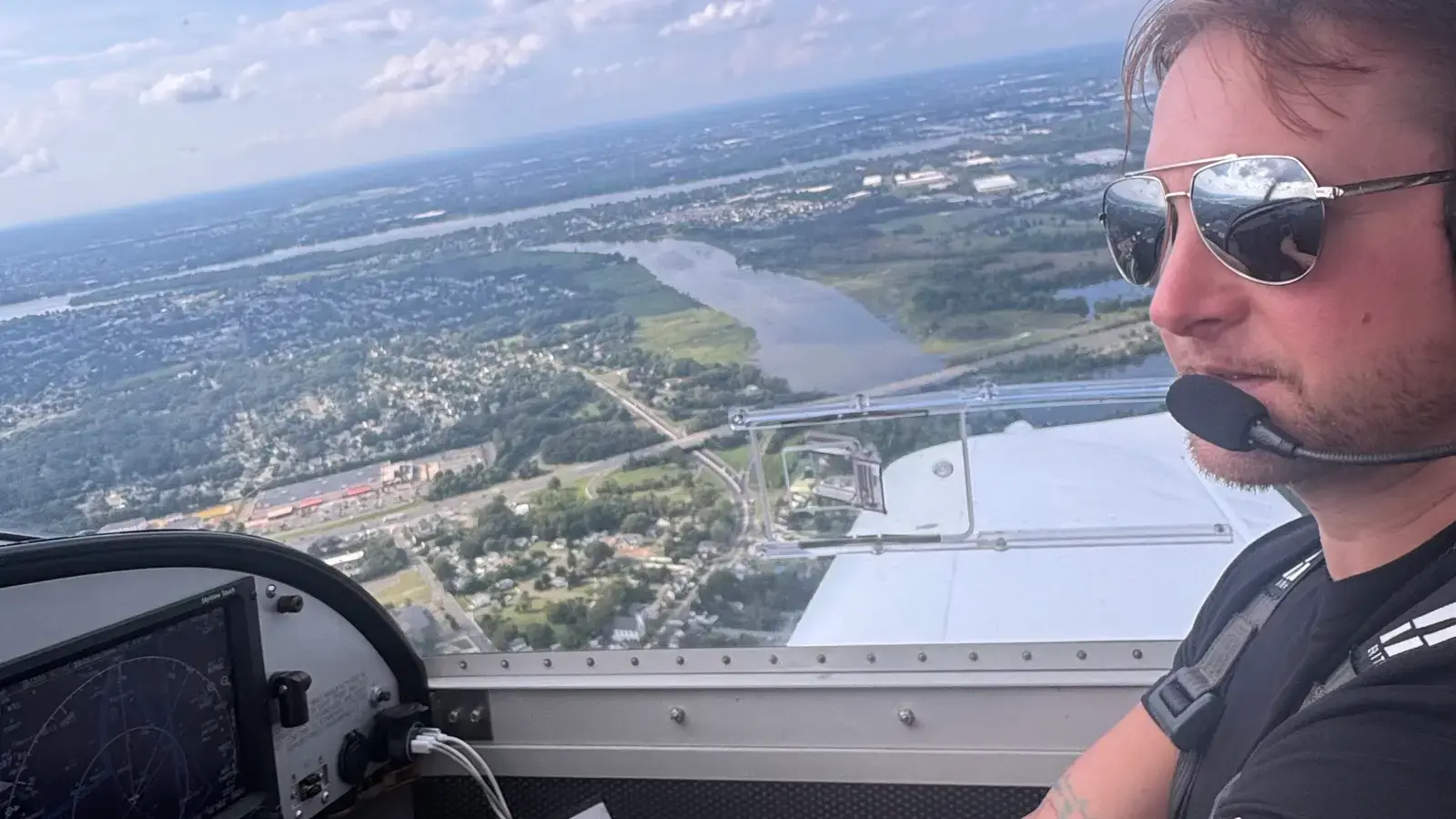
You can take flight lessons while you're in college in Philadelphia. Lessons are one-on-one and by appointment, so you book them around your classes, and you pay as you fly instead of by the semester.
Merlin Flight Training is a Part 61 flight school at Northeast Philadelphia Airport (KPNE), about 11 to 16 miles by road from La Salle, Temple, Drexel and Penn. Our minimum age is 16. International students can train here too, once TSA approves them. We aren't affiliated with any college.
How do flight lessons fit around classes and exams?
There's no cohort and no fixed class time. Each lesson is you, one instructor and the airplane: N159G, a two-seat Direct Fly Alto. We have afternoon, evening and weekend availability, and you pick lesson times in our scheduling calendar.
A lesson takes more of your day than the flight itself. Each one has a ground briefing, the preflight inspection, the flight and a debrief, so plan on a few hours at the airport, plus the trip there and back.
A plan that works with a semester:
- Start of term. Once your class schedule is set, pick two regular lesson slots and keep them all semester.
- Midterms and finals. Tell your instructor a couple of weeks ahead. Drop to one lesson that week, or swap a flight for a ground lesson. A light week costs you less than a month off.
- Breaks. If you stay in town, breaks are when you can fly more often. If you go home, expect a few review flights when you come back.
- Weather days. Weather cancellations carry no penalty, and we reschedule at no charge. Keep a backup slot in your week.
We aren't running a ground school class right now. Students use an online course or one-on-one ground lessons, so you study on your own schedule.
What's a realistic pace for a student?
With at least two lessons a week, a consistent schedule, no long gaps and regular study, finishing a private pilot certificate in about seven months is realistic. October to May is one example, which is close to one academic year. It isn't a guarantee: every student progresses at a different pace, and weather moves lessons.
The FAA sets minimum flight experience, not a calendar. A private pilot certificate takes at least 40 hours of flight time (14 CFR 61.109), and we budget for 55 to 65, because most students need more than the minimum.
Once a week can work, but the calendar stretches and more of each lesson goes to review. A summer away is the gap to plan for. Accelerated vs part-time training shows what changes at each pace.
How much should you budget?
There's no student discount. Every student pays the same rates: $185 an hour for the airplane and $75 an hour for instruction, which covers your instructor's time on the ground and in the air.
You don't pay for a certificate up front. These are the ways to start:
| Way to start | You pay | What you get |
|---|---|---|
| Discovery flight | $249 | An introductory flight lesson. $100 deposit online, $149 at the airport |
| Training deposit | $1,000 | Start smaller and pay as you fly |
| 10-hour block | $2,600 | $2,650 of training credit ($50 free) |
| 20-hour package | $5,200 | $5,400 of training credit ($200 free) |
| 40-hour package | $10,000 | $11,000 of training credit ($1,000 free) |
Lessons come off your balance, and you top it up when it runs low.
The discovery flight is free with a 10-hour block purchase. You pay $249 for the flight. When you buy your first training block (10, 20 or 40 hours), we credit the $249 back to your account.
Prepaid blocks aren't refundable. Any unused balance stays on your account as credit for future flying, so if you might leave Philadelphia after graduation, buy blocks sized to what you'll fly before you go.
For the whole certificate, the high end of our itemized private pilot estimate is $21,414, with ground school, FAA tests, the medical, the examiner and gear included. Current rates are on training options, and how to pay for flight training covers the costs outside the hourly rate.
How do you get to KPNE from campus?
We're at 9800 Ashton Rd, Hangar E3, Philadelphia, PA 19114, in Northeast Philadelphia. Plan on a car or a rideshare for most lessons. Parking at the field is free.
| Coming from | Driving distance to 9800 Ashton Rd |
|---|---|
| Holy Family University | About 1.5 miles |
| La Salle University | About 11 miles |
| Temple University (main campus) | 13 to 14 miles |
| Rutgers University–Camden | 14 to 15 miles |
| Drexel University | About 15 miles |
| University of Pennsylvania | About 16 miles |
| Saint Joseph's University | 16 to 20 miles |
| Villanova University | 25 to 33 miles |
Distances are from OpenStreetMap routing, checked in November 2026. A range covers the different routes it offers.
Without traffic, the routing puts La Salle, Temple, Drexel and Penn roughly half an hour away. Rush hour takes longer.
There is a bus. SEPTA's Route 20 runs from Frankford Transit Center, where it connects with the L, and SEPTA lists Route 20 stops at Academy Road and Grant Avenue, near the airport's Ashton Road address. Check SEPTA's schedule for your day and time, and ask us where to meet before you count on the walk from the stop to the hangar.
What paperwork do you need?
US citizens
Before flight training starts, we have to see government-issued proof of your citizenship (49 CFR 1552.7). Common examples are an unexpired US passport, or a birth certificate plus a government photo ID. TSA posts the list of accepted documents on the FTSP Portal. If yours is at your parents' house, have it sent before your first lesson.
Non-US citizens
If you aren't a US citizen, you need approval from the TSA Flight Training Security Program (FTSP) before flight training starts, and that includes green card holders. The approval is called a Determination of Eligibility (49 CFR 1552.31).
- A discovery flight is exempt. The rule leaves discovery flights and ground training out of its definition of flight training (49 CFR 1552.3), so you can take one first and study while you wait.
- Start early. TSA processes complete applications within 30 days (49 CFR 1552.31). In most cases, flight training can begin once you hold your approval and more than 30 days have passed since TSA acknowledged our training notice (49 CFR 1552.51). We suggest applying at least 60 days before you want to start lessons, and we can't promise an approval date.
- Contact us before you apply. Merlin is registered with TSA as a flight training provider, and we help with the application.
The steps are on our international students page and in our TSA Flight Training Security Program guide.
F-1 students
F-1 students are welcome at Merlin, with the TSA approval above.
- Your own university keeps your I-20. A Form I-20 comes from the designated school official (DSO) at an SEVP-certified school (Study in the States), and for you that's your university.
- Merlin can't issue an I-20 or sponsor a visa. SEVP requires a flight school to hold FAA Part 141 or Part 142 certification (ICE), and we're a Part 61 school.
- Ask your DSO before you apply. Your DSO is the right person for questions about your status, including how flight lessons fit with it. We don't give immigration advice.
To get a student pilot certificate, you also have to be able to read, speak, write and understand English (14 CFR 61.83).
Should you go for sport pilot or private pilot?
We train for both in the same airplane.
| Sport pilot | Private pilot | |
|---|---|---|
| FAA minimum flight time | 20 hours (61.313) | 40 hours (61.109) |
| Medical | A US driver's license, if you meet the conditions, or an FAA medical (61.23) | At least a third-class FAA medical, or BasicMed if you qualify (61.23) |
| Passengers | One (61.315) | More than one, if the airplane has the seats |
Three things usually decide it for college students:
- Budget and time. Sport has the lower minimum, so it can cost less.
- Career plans. An instrument rating and a commercial certificate both require at least a private pilot certificate (61.65, 61.123).
- Flying outside the US. A sport pilot certificate carries the limit "Holder does not meet ICAO requirements," and you can't use it outside the United States without that country's prior authorization (61.315). If you plan to fly at home after graduation, ask your country's civil aviation authority what it recognizes before you choose.
You don't have to decide on day one. The hours you log with our instructors toward sport pilot also count toward a private certificate later. Sport pilot vs private pilot compares the two in full, and our third-class medical guide explains the exam.
What happens to your training after graduation?
It goes with you.
- Your logbook is yours. Every lesson is logged and signed by your instructor (14 CFR 61.51).
- FAA certificates are national. Pilot certificates are issued under federal rules, 14 CFR Part 61, so yours isn't tied to Pennsylvania. It has no expiration date (61.19). To keep acting as pilot in command, you complete a flight review every 24 calendar months (61.56).
- If you move mid-training, an instructor near your new home can pick up from your logbook. Ask the new school how it credits earlier training.
Common questions
Is there a student discount? No. Every student pays the same hourly rates. Two savings apply to everyone: each training block comes with free credit, and the discovery flight is free with a 10-hour block purchase, credited back when you buy your first training block.
Can international students take flying lessons in Philadelphia? Yes. You need TSA Flight Training Security Program approval before flight training starts (49 CFR 1552.31). A discovery flight doesn't need it.
Do I need a car? It's the easiest way. A rideshare works, and SEPTA's Route 20 stops near the airport's address. If you're coming by bus, ask us where to meet.
I'm 17. Can I start? Yes. Our minimum age is 16, and anyone under 18 needs a parent or guardian's consent form. The FAA's minimum age is 16 for a student pilot certificate (61.83) and 17 for a private or sport pilot certificate in an airplane (61.103, 61.305).
The next step is a discovery flight: an introductory Part 61 flight lesson at KPNE, where you fly the airplane with an instructor beside you. You don't need a medical certificate or TSA approval for it. Book a discovery flight.
Ready to try it yourself?