
KPNE · Northeast Philadelphia
Sport Pilot Training
Earn an FAA sport pilot certificate at Northeast Philadelphia Airport. The FAA minimum is 20 hours of flight time, and a U.S. driver's license can take the place of an FAA medical if you meet the conditions.
- hours, the FAA minimum
- 20
- passenger at a time
- 1
- minimum age for the certificate
- 17
What a sport pilot can do
A sport pilot certificate lets you fly a small airplane yourself, for fun. The FAA's MOSAIC rule widened what sport pilots can fly. Its pilot rules took effect on October 22, 2025.
You can
- Fly an airplane with up to 4 seats and a flaps-up stall speed of 59 knots or less, plus a few other design limits. It doesn't have to be a light-sport aircraft. (14 CFR 61.316)
- Carry one passenger. You can split the flight's costs with them, as long as you pay at least half. (14 CFR 61.315)
- Fly at towered airports and in Class B, C and D airspace, after training and an instructor's endorsement. (14 CFR 61.325)
- Fly at night, after 3 hours of night training and an endorsement, if you also hold an FAA medical or meet BasicMed. (14 CFR 61.329)
- Fly an airplane with retractable landing gear or a manually controlled propeller, after training and an endorsement for each. (14 CFR 61.331)
The limits
- One passenger at most, even in a 4-seat airplane.
- No flying for pay or for a business.
- No higher than 10,000 feet above sea level, or 2,000 feet above the ground if that's higher.
- At least 3 statute miles of visibility, with the ground in sight.
- No night flying on a driver's license alone.
- Outside the United States, only with that country's permission.
14 CFR 61.315
What you need
Four things, set by the FAA.
Age
17
You can fly solo as a student pilot at 16 and earn the certificate at 17. You also need to read, speak, write and understand English.
14 CFR 61.83, 61.305
Flight time
20 hours
The FAA minimum: 15 with an instructor and 5 solo. It includes 2 hours of cross-country training, 10 takeoffs and landings to a full stop, one solo cross-country of at least 75 nautical miles and 2 hours of checkride prep.
14 CFR 61.313
Tests
2 tests
The FAA sport pilot knowledge test, taken at a testing center, and a practical test (the checkride) with an examiner. Your instructor endorses you for each one.
14 CFR 61.307
Medical
Driver's license
A valid U.S. driver's license in place of an FAA medical, if you meet the four conditions below. An FAA medical certificate works too.
14 CFR 61.23(c)
A driver's license in place of an FAA medical
All four have to be true.
- You hold a valid U.S. driver's license and follow every restriction on it, such as corrective lenses, and any court or agency order about your driving.
- If you have ever applied for an FAA medical certificate, the FAA found you eligible for at least a third-class medical on your most recent application.
- If you have ever held an FAA medical certificate, your most recent one was not suspended or revoked, and your most recent special issuance was not withdrawn.
- You do not know of, or have reason to know of, any medical condition that would make you unable to fly safely.
The same rule covers your solo flights as a student working toward a sport pilot certificate.
Before you apply for a medical: If you apply for an FAA medical and it is denied, you can't use a driver's license for sport flying until that is resolved. If a condition worries you, talk with an aviation medical examiner before you file an application.
14 CFR 61.23(c)(2), 61.303(b). General information only, not medical or legal advice.
Why Merlin
You train in a light-sport airplane
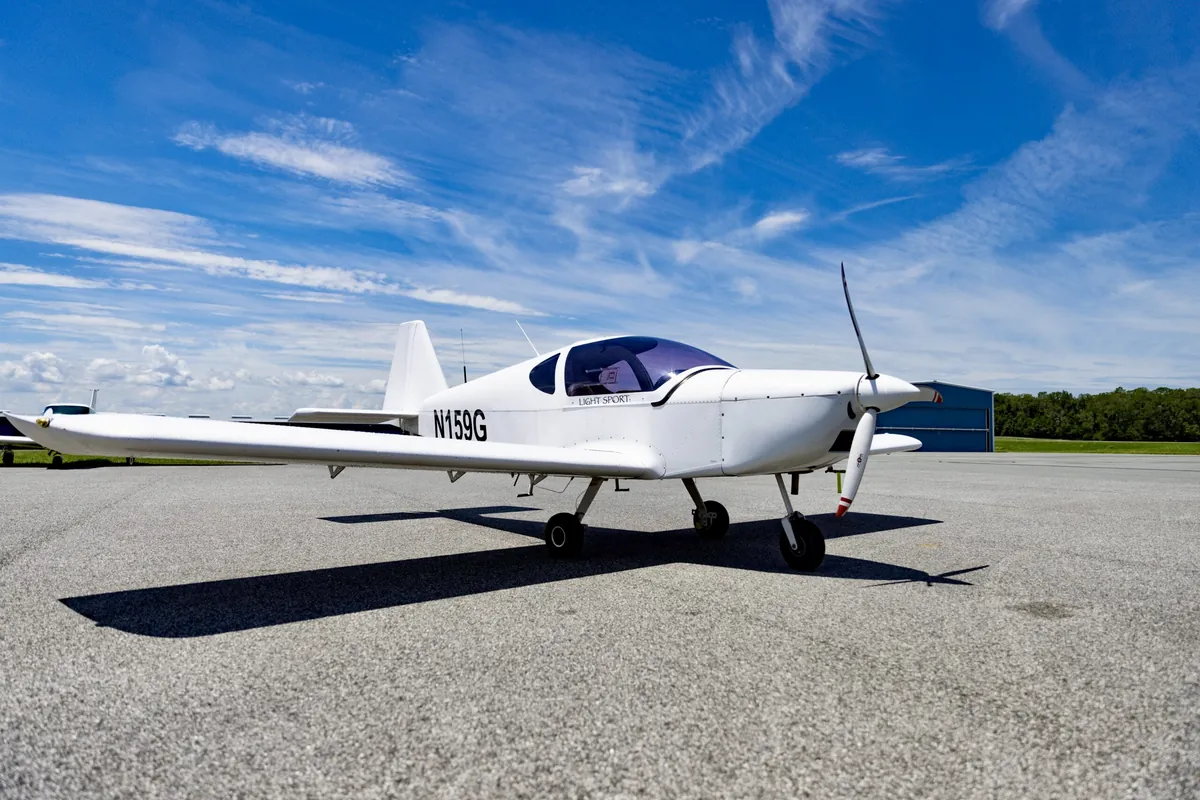
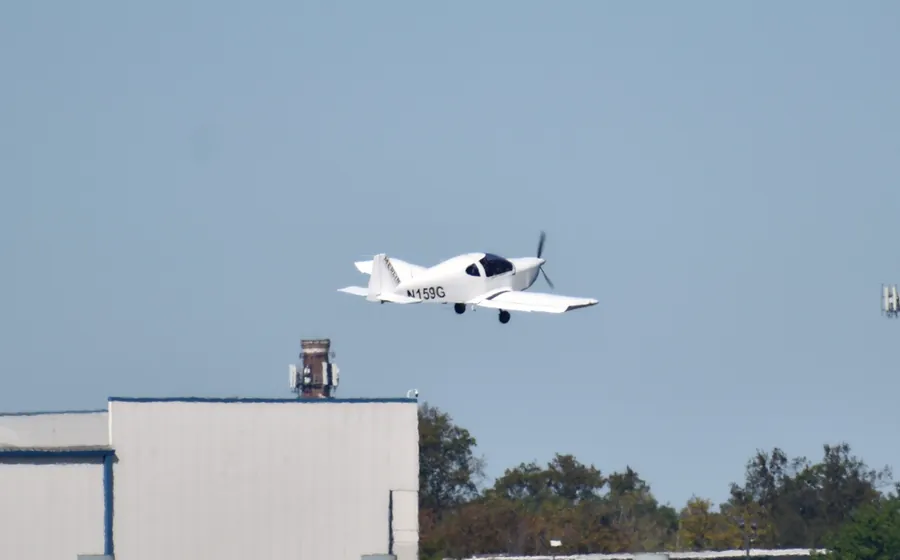
We train in N159G, a Direct Fly Alto 912 TG. It is a factory-built special light-sport aircraft, so the airplane you learn in is one you can fly as a sport pilot.
- Two seats, side by side
- Flaps-up stall speed of 41 knots, inside the 59-knot sport pilot limit
- Rotax 912 engine and a Dynon SkyView glass panel
- Flown in visual conditions only (VFR)
- One-on-one lessons under FAA Part 61
Which endorsements apply
Two logbook endorsements come with training here. Your instructor gives you both.
Faster airplanes
N159G cruises at about 100 knots, above the 87-knot line in the sport pilot rules. So you get the training and endorsement for airplanes faster than 87 knots.
14 CFR 61.327(b)
Towered airports and Class B, C and D airspace
KPNE has a control tower and sits under Philadelphia's Class B airspace. You can't fly from here without this endorsement, so it is part of your training.
14 CFR 61.325
Night flying is a separate add-on: 3 hours of night training and an endorsement, and you need an FAA medical or BasicMed (14 CFR 61.329).
See the airplane →What it costs at Merlin
At $185 an hour for the airplane and $75 an hour for instruction, this is the FAA minimum in dollars.
The FAA Minimum, Itemized
| Item | Basis | Amount |
|---|---|---|
| Airplane (N159G)20 hrs × $185 | 20 hrs × $185 | $3,700 |
| Flight instruction18 hrs × $75 (15 hrs of dual flying, plus briefings) | 18 hrs × $75 (15 hrs of dual flying, plus briefings) | $1,350 |
| FAA knowledge testTesting center fee | Testing center fee | $175 |
| FAA medicalNot needed if you fly on your driver's license | Not needed if you fly on your driver's license | $0 |
| Headset and basic kitBudget to premium | Budget to premium | $325–$1,250 |
| At the FAA minimum20 hours, before the checkride | 20 hours, before the checkride | $5,550–$6,475 |
This is the FAA minimum, not an estimate of your total. Most people take more than the minimum.
- Each extra hour with an instructor adds about $275: $185 for the airplane plus about 1.2 hours of instructor time, briefings included.
- The examiner sets the checkride fee and you pay it to them, so it isn't in this table.
- Studying for the knowledge test is separate. The FAA's handbooks are free. An online course or ground lessons with your instructor cost extra.
Rates as of October 2026.
Paying for it
Start with a $1,000 training deposit and pay as you fly, or prepay a block of 10, 20 or 40 hours (from $2,600). Lessons come off your balance.
Every training block comes with free credit: $50 with the 10-hour block ($2,600), $200 with the 20-hour package ($5,200) and $1,000 with the 40-hour package ($10,000).
See the ways to pay →Sport or private
Sport is quicker and simpler. Private does more.
| Sport pilot | Private pilot |
|---|---|
| FAA minimum flight time | |
| 20 hours (15 with an instructor and 5 solo) | 40 hours (20 with an instructor and 10 solo) |
| Minimum age for the certificate | |
| 17 | 17 |
| Medical | |
| A U.S. driver's license, if you meet the conditions, or an FAA medical | An FAA medical (third class or higher) or BasicMed |
| Passengers | |
| 1 | As many as the airplane seats |
| Night flying | |
| Only after 3 hours of night training and an endorsement, and with an FAA medical or BasicMed | Yes. Night training is part of the certificate |
| Airplanes | |
| Up to 4 seats and a flaps-up stall speed of 59 knots or less | Any single-engine land airplane you're checked out in |
| Maximum altitude | |
| 10,000 feet above sea level, or 2,000 feet above the ground if that's higher | Normal VFR rules |
| Towered airports and Class B, C and D airspace | |
| With an instructor's endorsement | Included in training |
| Cost at Merlin | |
| $5,550–$6,475 at the 20-hour FAA minimum, before the checkride | $16,625–$21,414 estimated, for 55–65 flight hours with the checkride |
The two cost rows aren't measured the same way. Sport shows the FAA minimum of 20 hours. Private shows our estimate at 55–65 hours, well above its 40-hour FAA minimum.
Sources: 14 CFR 61.23, 61.305, 61.313, 61.315, 61.316, 61.325 and 61.329 (sport); 61.103 and 61.109 (private).
Sport time counts toward private
Every hour you log with us toward a sport pilot certificate counts toward a private pilot certificate later. To move up, you add what private requires and sport doesn't: night training, flying by reference to instruments, longer cross-country flights and an FAA medical or BasicMed (14 CFR 61.109, 61.23).
See private pilot training →How to start
Your first step is one flight.
Book a discovery flight
An introductory flight lesson in N159G with an instructor beside you. You fly the airplane. It costs $249. You need to be at least 16. If you're under 18, a parent or guardian signs our consent form.
Regular price
$249FREEwith a 10-hour block purchaseYou pay $249 for the flight. Buy a 10-hour block ($2,600) and we credit the $249 back to your account.
Pick your path in the debrief
Tell us what you want to do with flying. We lay out sport and private side by side for your goals and your schedule.
Do the paperwork
Bring proof of U.S. citizenship, like a passport or birth certificate. If you aren't a U.S. citizen, you need TSA approval before training starts, and we help with the application (49 CFR 1552.7, 1552.31). We also help you apply for the student pilot certificate you need before you solo.
Start training
Start with a $1,000 training deposit and pay as you fly, or prepay a block of 10, 20 or 40 hours (from $2,600). Lessons come off your balance.
Solo, knowledge test, checkride
Fly solo, pass the FAA knowledge test, then take the checkride with an examiner.
Sport pilot questions
Can I fly with just a driver's license?
Yes, as a sport pilot in the daytime, if you meet four conditions. You hold a valid U.S. driver's license and follow its restrictions. If you have ever applied for an FAA medical, you were found eligible on your most recent application. Your most recent medical was not suspended or revoked, and your most recent special issuance was not withdrawn. And you don't know of, or have reason to know of, a medical condition that would make you unable to fly safely (14 CFR 61.23(c)).
How many hours does a sport pilot certificate take?
The FAA minimum is 20 hours of flight time: 15 with an instructor and 5 solo (14 CFR 61.313). Most people take more than the minimum. How many more depends on how often you fly and how you progress. We talk through a plan for your schedule in your discovery flight debrief.
How much does a sport pilot certificate cost at Merlin?
At the FAA minimum of 20 hours, the flying costs $5,050 at our rates: 20 hours × $185 for the airplane plus 18 hours × $75 for instruction. With the knowledge test ($175) and a headset and basic kit ($325–$1,250), that's $5,550–$6,475 before the checkride. The examiner sets the checkride fee. Most people take more than the minimum, and each extra hour with an instructor adds about $275.
Does sport pilot training count toward a private pilot certificate?
Every hour you log with us toward a sport pilot certificate counts toward a private pilot certificate later. To move up, you add what private requires and sport doesn't: night training, flying by reference to instruments, longer cross-country flights and an FAA medical or BasicMed (14 CFR 61.109, 61.23).
Can a sport pilot fly at night?
Yes, with three things: 3 hours of night training, an instructor's endorsement, and an FAA medical certificate or BasicMed (14 CFR 61.329). A driver's license alone doesn't cover night flying.
Is your airplane a light-sport airplane?
Yes. N159G is a Direct Fly Alto 912 TG, a factory-built special light-sport aircraft with two seats and a flaps-up stall speed of 41 knots, inside the sport pilot limits. It cruises at about 100 knots, above the 87-knot line in the sport pilot rules, so your instructor also gives you the training and logbook endorsement for faster airplanes (14 CFR 61.327(b)).
How old do I have to be?
You can fly solo as a student pilot at 16 and earn the sport pilot certificate at 17 (14 CFR 61.83, 61.305). You can take a discovery flight at 16. If you're under 18, a parent or guardian signs our consent form.
Should I get a sport or a private pilot certificate?
Sport fits if you want to fly for fun in the daytime with one passenger, or you would rather use your driver's license than go through the FAA medical. Private fits if you want more than one passenger, night flying as a normal part of your flying, or more ratings later: instrument, commercial and flight instructor training build on a private certificate. You can start with sport and move up to private.
More on the sport pilot certificate
FAA and TSA rules checked November 11, 2026: 14 CFR 61.23 · 14 CFR 61.83 · 14 CFR 61.303 · 14 CFR 61.305 · 14 CFR 61.307 · 14 CFR 61.313 · 14 CFR 61.315 · 14 CFR 61.316 · 14 CFR 61.325 · 14 CFR 61.327 · 14 CFR 61.329 · 14 CFR 61.331 · 14 CFR 61.103 · 14 CFR 61.109 · 49 CFR 1552.7 · 49 CFR 1552.31. General information, not legal advice.
Fly the airplane first.
A discovery flight is an introductory flight lesson in N159G. Afterward we talk through sport and private for you. Questions first? Call or text (445) 456-3599.