
Flight Lessons for Teenagers: A Parent's Guide (Ages 16 and 17)
Isaac Prestwich, CFII · November 10, 2026
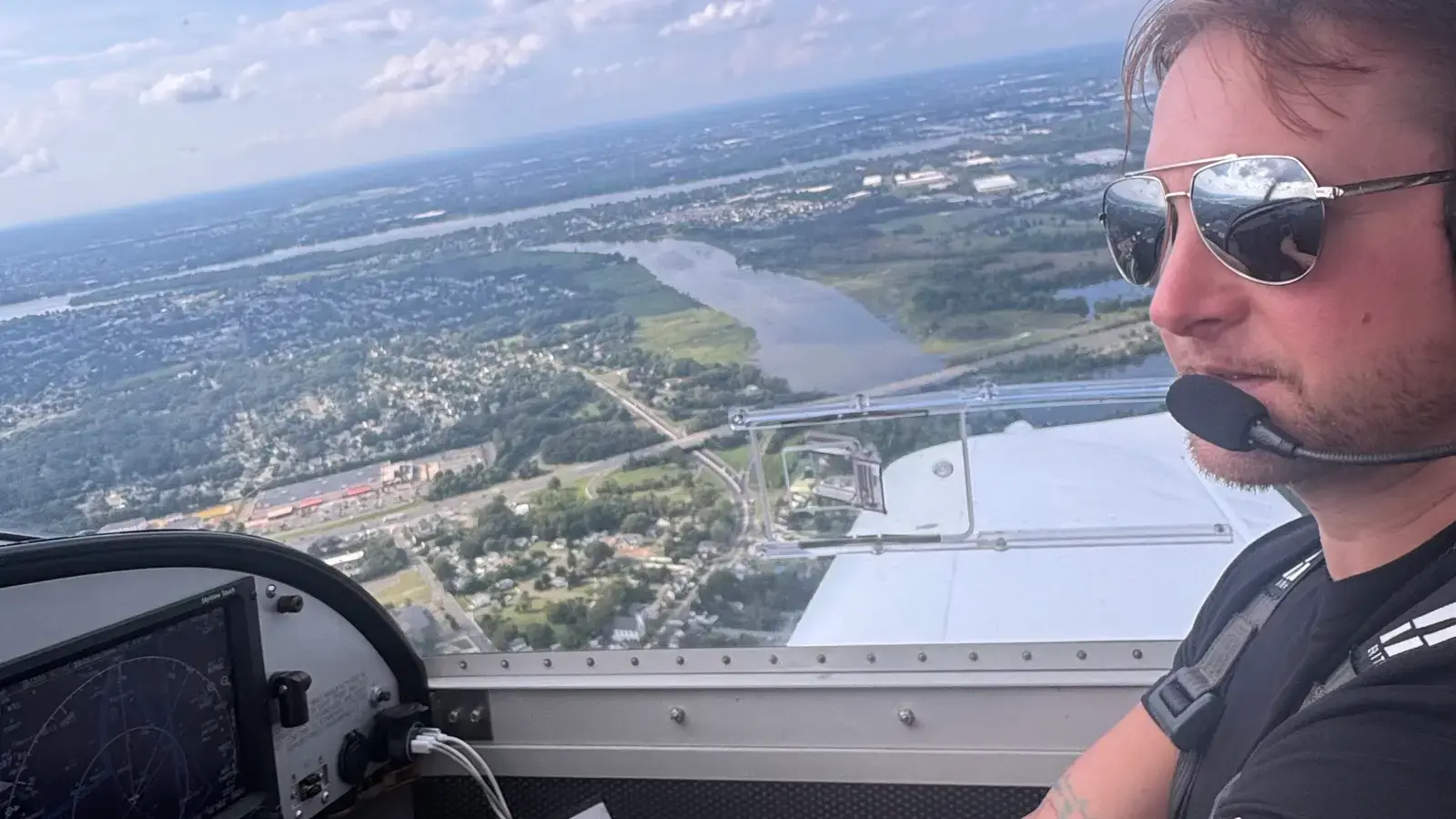
Yes, a 16-year-old can take flying lessons. At Merlin Flight Training the minimum age is 16, and if your teen is under 18, a parent or guardian signs a consent form.
The FAA's ages line up with that. A student pilot certificate, which your teen needs before flying an airplane solo, starts at 16 (14 CFR 61.83). A private pilot certificate or a sport pilot certificate for airplanes starts at 17 (14 CFR 61.103, 14 CFR 61.305).
We're a Part 61 flight school at Northeast Philadelphia Airport (KPNE), and every lesson is one student with one FAA-certificated flight instructor.
How old does a teenager have to be to take flying lessons?
| Age | What your teen can do | Where it comes from |
|---|---|---|
| 16 | Take a discovery flight or enroll with us, with a parent or guardian's consent form | Merlin's policy |
| 16 | Hold a student pilot certificate, which is required before flying an airplane solo | 14 CFR 61.83, FAA |
| 17 | Earn a private pilot certificate for airplanes | 14 CFR 61.103 |
| 17 | Earn a sport pilot certificate for airplanes | 14 CFR 61.305 |
Your teen doesn't need a student pilot certificate to take lessons with an instructor, only to fly solo (FAA). Our minimum age guide goes through each milestone, including the written test.
What does a parent need to do?
- Sign the consent form. For a discovery flight, we send the parental consent form once the flight date is set, and your teen brings it signed on the day. A parent or guardian signs consent paperwork for enrollment too.
- Come to the first visit if you'd like. Tell us when you book, and we'll text the meeting point. The airplane has two seats, so you stay on the ground. The debrief afterward is a good time to ask about cost, medicals and scheduling.
- Have proof of citizenship ready before training starts. TSA requires a flight school to examine government-issued proof of U.S. citizenship before it gives flight training (49 CFR 1552.7). TSA posts the list of acceptable documents on the FTSP Portal. Common examples are an unexpired U.S. passport, or a birth certificate plus a government photo ID. A discovery flight doesn't need this.
- Help schedule the FAA medical exam. On the private pilot track, your teen needs a medical certificate before flying solo.
- Decide how you'll start paying: a deposit or a prepaid block.
If your teen isn't a U.S. citizen, and that includes green card holders, TSA approval comes before flight training. A discovery flight is exempt, because TSA's rule leaves discovery flights out of its definition of flight training (49 CFR 1552.3). Our TSA guide explains the steps and the timing.
Does a teenager need an FAA medical exam?
Not for lessons with an instructor. A student working toward a private pilot certificate needs at least a third-class medical certificate before flying solo (14 CFR 61.23(a)(3)).
Two things to know:
- One exam can last through training. For anyone under 40 on the exam date, a third-class medical used for student or private pilot flying lasts through the end of the 60th month after the month of the exam (14 CFR 61.23(d)).
- Earlier is better. The FAA's Aeronautical Information Manual tells student pilots to see an aviation medical examiner as soon as possible, so a medical issue doesn't surface after you've paid for training (AIM 8-1-1).
Sport pilot training has another option. A student who holds a valid U.S. driver's license and meets the conditions in 14 CFR 61.23(c) can use it in place of a medical certificate.
Our third-class medical guide explains the application and the exam. We're flight instructors, not doctors, so questions about a medication or a diagnosis go to an aviation medical examiner before your teen applies.
How do flight lessons fit around a school week?
We have afternoon, evening and weekend availability, and you pick lesson times in our scheduling calendar. What helps a high school student most:
- A steady rhythm. Our planning figure for students who train two to three times a week is 6 to 12 months to a private pilot certificate. Long gaps mean relearning. We can't guarantee a finish date, because weather, school and how often your teen flies all move it.
- Study at home. We aren't running a ground school class right now. Students use an online course or one-on-one ground lessons, and an online course can be done on school nights.
One timing note: your teen can't earn the private pilot certificate before turning 17, so a student who starts right at 16 can pace training toward that birthday.
What do flight lessons cost for a teenager?
There's no separate teen rate. Our published rates are $185 an hour for the airplane and $75 an hour for instruction.
The ways to start:
- Discovery flight: $249. You pay a $100 deposit when you book online and the $149 balance at the airport by card or cash.
- Training deposit: $1,000, to start smaller and pay as your teen flies.
- Prepaid training block: a 10-hour block for $2,600, a 20-hour package for $5,200 or a 40-hour package for $10,000. Each comes with free credit: $50, $200 and $1,000.
Lessons come out of the balance as they're flown, and you top it up when it runs low. You never pay the full estimate up front. Prepaid blocks aren't refundable, but any unused balance stays on the account as credit for future flying.
For the whole private pilot certificate, the high end of our estimate is $21,414 all in. That plans for 65 flight hours, against an FAA minimum of 40 (14 CFR 61.109), and includes ground school, the written test, the medical, the examiner's fee and gear. It's a planning estimate, not a quote. The itemized cost breakdown shows every line.
Scholarships are worth a look at this age. AOPA, for example, lists a high school flight training scholarship for students ages 16 to 18 on its scholarship page. Each program sets its own rules and deadlines. Our flight training scholarships guide covers where to look.
How is safety built into flight training?
Flying a small airplane carries risk, and no school can honestly promise otherwise. Training teaches a new pilot to manage that risk, one habit at a time.
- An instructor is on board for every flight until your teen is signed off to solo. Our Direct Fly Alto has dual control sticks. The instructor can take the controls at any moment, and your teen can hand them back at any time.
- Every flight starts with a preflight inspection. Student and instructor check the fuel, oil, control surfaces, tires and propeller, and your teen learns to work from the airplane's written checklists instead of memory.
- Weather is checked before every flight. If conditions aren't safe, we reschedule. Weather cancellations carry no penalty and no charge.
- The pilot gets checked too. Students learn the FAA's personal checklist, known as IMSAFE: illness, medication, stress, alcohol, fatigue and emotion (AIM 8-1-1).
- Solo has no hour count that triggers it. Under 14 CFR 61.87, a student must pass a pre-solo knowledge test and show an instructor proficiency and safety on a list of maneuvers that includes stall recovery, emergency procedures and go-arounds. The instructor's solo endorsement has to be renewed every 90 days.
- Solo has limits. A student pilot can't carry a passenger, and must follow any limits the instructor writes in the logbook, such as a maximum wind (14 CFR 61.89).
- The airplane is inspected on a schedule. A light-sport airplane that a school provides for paid flight training must have been inspected within the previous 100 hours of time in service, and it needs a condition inspection every 12 calendar months (14 CFR 91.327).
Where can flying lead after high school?
For some students, the private pilot certificate is the goal itself: flying for its own sake, with family or friends aboard.
For others it's the first step on a career ladder: private certificate, instrument rating, commercial certificate (minimum age 18 under 14 CFR 61.123), usually a flight instructor certificate, then an airline transport pilot certificate. Our career roadmap lays out the steps, and our private pilot to airline career path guide covers what the FAA requires at each one.
What we won't tell you:
- That it leads to a job. No flight school can guarantee an airline job, and we don't.
- That it helps with college admissions. We don't know how any admissions office weighs it. If a college has an aviation program, ask how it treats a certificate earned beforehand.
If your teen is serious about a flying career, think about the medical first. The FAA advises students headed for commercial aviation to apply for the highest class of medical certificate they might need (AIM 8-1-1).
Is a discovery flight the right first step?
Yes. A discovery flight is an introductory flight lesson under Part 61, and it lets your teen try flying before you commit to training. It includes:
- A ground briefing on how the airplane flies
- A preflight walkaround of N159G, our two-seat Direct Fly Alto
- Time on the controls with the instructor: turns, climbs and descents
- A debrief, and a logbook entry for the flight
It's booked as a one-hour lesson, so plan on about 90 minutes at the airport. The time is logged as instruction and counts toward a pilot certificate. No medical, student pilot certificate or TSA paperwork is needed, only the signed consent form and a photo ID.
The discovery flight is free with a 10-hour block purchase. You pay $249 for the flight. If your teen continues and you buy a 10-hour block ($2,600), we credit the $249 back to the account.
If it's a present, say for a 16th birthday, a discovery flight gift card never expires and has no fees, and your teen picks the date. The buyer can get a full refund within 30 days if it hasn't been flown.
Common questions
Can I ride along on my teen's lesson? No. The airplane has two seats, one for the student and one for the instructor. You're welcome to come to the airport.
Does my teen need a driver's license to take flying lessons? No. The FAA's student pilot requirements are age and English (14 CFR 61.83). Your teen does need a photo ID. For solo flight, the FAA's list includes a passport, a driver's license and a state-issued ID card (14 CFR 61.3).
What if my teen tries it and doesn't want to continue? Then you've paid for one lesson and nothing more. There's no pressure at the debrief to sign up for anything.
Next step: book a discovery flight for your teen at Northeast Philadelphia Airport, 9800 Ashton Rd, Hangar E3, Philadelphia, PA 19114. If you have questions first, call or text (445) 456-3599.
Ready to try it yourself?