
How to Become a Pilot in Pennsylvania: Step by Step (2026)
Isaac Prestwich, CFII · November 10, 2026
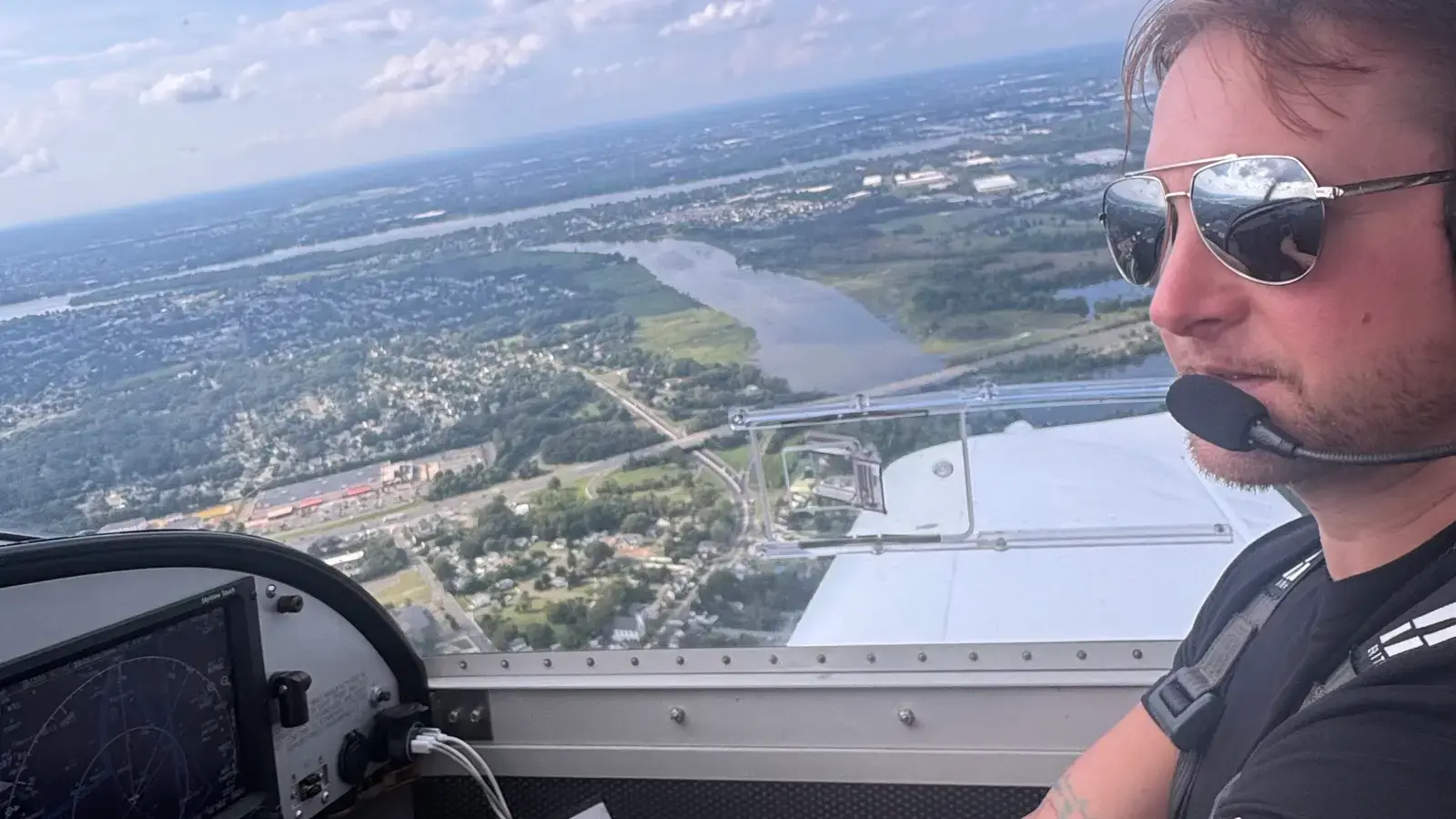
Pilot certificates are issued by the FAA under federal law (49 U.S.C. 44703), so there is no Pennsylvania pilot license, and the steps are the same here as in every other state. What's local is where you do each step: the airport you train at, the doctor you see, the testing center and the examiner.
Here are the steps for an airplane, in order, with the rule behind each. We're Merlin Flight Training, a Part 61 flight school at Northeast Philadelphia Airport (KPNE).
What are the steps to become a pilot in Pennsylvania?
- Take a discovery flight.
- Choose sport pilot or private pilot.
- Check that you're eligible.
- Settle the medical question.
- Apply for a student pilot certificate.
- Show proof of citizenship, or get TSA approval.
- Study, and pass the knowledge test.
- Fly the required training.
- Solo, then fly solo cross-country.
- Pass the checkride.
Steps 4 through 7 overlap with your flight lessons. Two points are fixed: the medical question and the student pilot certificate are settled before your first solo, and the knowledge test is passed before the checkride.
Step 1: Try a discovery flight
A discovery flight is an introductory flight lesson under Part 61. You fly the airplane with a certificated flight instructor beside you, and the time goes in a logbook and counts toward a certificate. You don't need a medical, a student pilot certificate or TSA approval for it.
At Merlin it costs $249: a $100 deposit online and $149 at the airport. The discovery flight is free with a 10-hour block purchase: you pay $249 for the flight, and when you buy a 10-hour block ($2,600) we credit the $249 back to your account. See what happens on a discovery flight.
Step 2: Should you go for sport pilot or private pilot?
Sport pilot is shorter and has a simpler medical path. Private pilot has fewer limits.
| Sport pilot | Private pilot | |
|---|---|---|
| FAA minimum flight time | 20 hours | 40 hours |
| Of that, with an instructor | 15 hours | 20 hours |
| Of that, solo | 5 hours | 10 hours |
| Minimum age for the certificate | 17 | 17 |
| Medical | A U.S. driver's license (with conditions) or an FAA medical | At least a third-class FAA medical |
| Passengers | One at most | More than one |
| Night flying | Only after extra training and an endorsement, and with a medical or BasicMed | Night training is part of the certificate |
Sources: 14 CFR 61.305, 61.313, 61.315 and 61.329 for sport pilot; 61.103 and 61.109 for private pilot; 61.23 for the medical.
We train for both at Merlin, in the same airplane, and the hours you log toward sport pilot also count toward a private certificate later. See sport pilot vs private pilot.
Step 3: Are you eligible?
The FAA's eligibility rules are short:
- Age 16 for a student pilot certificate, which you need before you fly an airplane solo (14 CFR 61.83).
- Age 17 for a sport pilot or private pilot certificate (61.305, 61.103).
- You can read, speak, write and understand English.
Merlin's minimum age is 16, and students under 18 need a parent or guardian's consent form. See our minimum age guide.
Step 4: Do you need a medical certificate, or is a driver's license enough?
It depends on the certificate.
Private pilot students need at least a third-class FAA medical certificate before they solo (14 CFR 61.23(a)(3)). You fill out the application online in MedXPress, then see an aviation medical examiner (AME) for the exam. To find one, use the FAA's own AME locator and search near your home or work. Our third-class medical guide covers the exam.
Sport pilot students can use a valid U.S. driver's license, such as a Pennsylvania license, in place of a medical certificate (61.23(c)). The conditions:
- You follow every restriction on the license.
- If you've ever applied for an FAA medical, your most recent application was found eligible.
- Your most recent FAA medical, if you've held one, wasn't suspended or revoked, and a special issuance wasn't withdrawn.
- You don't know of a medical condition that would make you unable to fly safely.
If your most recent FAA medical application was denied, the driver's license route is closed. So if you have a health concern, talk with an AME before you submit an application. Sport pilot medical rules has more.
Either way, settle this before you've spent much on lessons.
Step 5: How do you get a student pilot certificate?
You apply online in the FAA's IACRA system, then meet with your instructor, who checks your ID and submits the application. You need the certificate before you fly solo, not before lessons, and the FAA says the card arrives by mail in approximately three weeks (FAA). See our IACRA guide.
Step 6: What does TSA require before flight training?
TSA's rule applies to every student, and it depends on citizenship.
- U.S. citizens and U.S. nationals show government-issued proof of citizenship or nationality to the flight school before flight training starts (49 CFR 1552.7). You don't apply to TSA.
- If you're not a U.S. citizen or national, green card holders included, you need a Determination of Eligibility from TSA's Flight Training Security Program (FTSP) before flight training starts (49 CFR 1552.31).
A discovery flight and ground training aren't "flight training" under the rule (1552.3), so you can do both while you wait. Our TSA guide lists the steps and what to bring.
Step 7: How do you study for and take the knowledge test?
Part 61 doesn't require a classroom course. You either log ground training with an instructor or complete a home-study course (61.105(a) for private, 61.309 for sport). Merlin isn't running a ground school class right now, so our students use an online course or one-on-one ground lessons.
When you're ready, an instructor endorses you (61.35) and you book the test at a PSI testing center through PSI's FAA site. A passing result is good for 24 calendar months, and your checkride has to happen inside that window (61.39(a)(1)).
See how to prepare for the private pilot knowledge test.
Step 8: How many flight hours do you need?
The FAA sets a minimum, and most people fly more.
- Private pilot: at least 40 hours, including 20 with an instructor and 10 solo. Inside those hours are 3 hours of cross-country training, 3 hours of night training and 3 hours of flying by reference to instruments (14 CFR 61.109(a)).
- Sport pilot: at least 20 hours, including 15 with an instructor and 5 solo (14 CFR 61.313).
Those are legal floors. Merlin's private pilot estimate plans for 55 to 65 flight hours, and you should plan on more than 20 for sport pilot too. The private pilot requirements checklist breaks down every required hour.
You'd train in N159G, our two-seat Direct Fly Alto 912 TG.
Step 9: When do you solo and fly cross-country?
No rule sets a minimum number of hours before your first solo. Your instructor trains you on the pre-solo maneuvers, gives you a pre-solo knowledge test and endorses your logbook when you're ready (14 CFR 61.87). See first solo requirements.
Solo cross-country comes next, with more training and more endorsements before you fly solo more than 25 nautical miles from the airport you took off from, or land anywhere else (61.93). Private students fly one solo cross-country of 150 nautical miles total. Sport students fly one of at least 75. See our solo cross-country guide.
Step 10: What is the checkride?
The checkride is the FAA practical test. You usually take it with a designated pilot examiner (DPE), who represents the FAA for the test (14 CFR 61.47), and you're graded on the tasks in the FAA's published test standards for your certificate (61.43). Before it, you need a passing knowledge test, the required training and experience in your logbook, and an instructor's endorsement that you've trained within the preceding 2 calendar months and are prepared (61.39).
Each examiner sets their own fee. See what to expect on checkride day.
How much does it cost to become a pilot in Pennsylvania?
It depends on the certificate and on how many hours you need. At Merlin, the airplane is $185 an hour and instruction is $75 an hour. The high end of our all-in private pilot estimate is $21,414. That assumes 65 flight hours and includes ground study, the knowledge test, the medical, the examiner's fee and gear. A sport pilot certificate usually costs less because it takes fewer hours.
You can start with a $1,000 training deposit and pay as you fly, or prepay a training block, starting at $2,600 for 10 hours.
Every line item is on the private pilot cost page and in our Philadelphia cost guide.
How long does it take?
For a private certificate, about seven months is realistic if you fly at least twice a week, keep a consistent schedule and study between lessons. Weather, your schedule and airplane availability all move the date, so we can't promise one. The private pilot timeline shows the phases.
What's different about learning to fly in Philadelphia?
Airspace. KPNE has an operating control tower and sits beneath part of Philadelphia's Class B airspace. You talk to air traffic control from your first lesson. For private students, solo takeoffs and full-stop landings here count toward the three required at a towered airport (61.109(a)(5)(iii)). Sport students need extra training and an endorsement to solo at a towered airport (61.94), and that's built into training here. Read our KPNE student guide and our Class B guide.
Seasons. There's no single best season to start. Weather cancels some lessons in every season, with no penalty and free rescheduling. See how each season affects lessons and what changes in winter.
We're at 9800 Ashton Rd, Hangar E3, Philadelphia, PA 19114.
Common questions
Does Pennsylvania issue its own pilot license? No. The FAA issues pilot certificates, and the one you earn here is the same one pilots earn in every other state.
Do I have to live in Pennsylvania to train here? No. The certificate is federal, and the FAA's eligibility rules don't mention where you live. Our students come from Philadelphia, Bucks County, Montgomery County and South Jersey.
What do I need before my first lesson? For a discovery flight, a booking. You must be at least 16, and under 18 you need a parent or guardian's consent form. The medical, the student pilot certificate and the TSA step come later.
Can I train if I'm not a U.S. citizen? Yes, once TSA approves you through the FTSP. Merlin is a Part 61 school, so we can't issue I-20s or sponsor visas. F-1 students are welcome, and your own school keeps your I-20. Start at our international students page.
The first step is a lesson. Book a discovery flight at Northeast Philadelphia Airport, or take the free pilot quiz to see which path fits you. Questions? Call or text (445) 456-3599.
Ready to try it yourself?