
What Can You Do With a Private Pilot License?
Isaac Prestwich, CFII · November 10, 2026
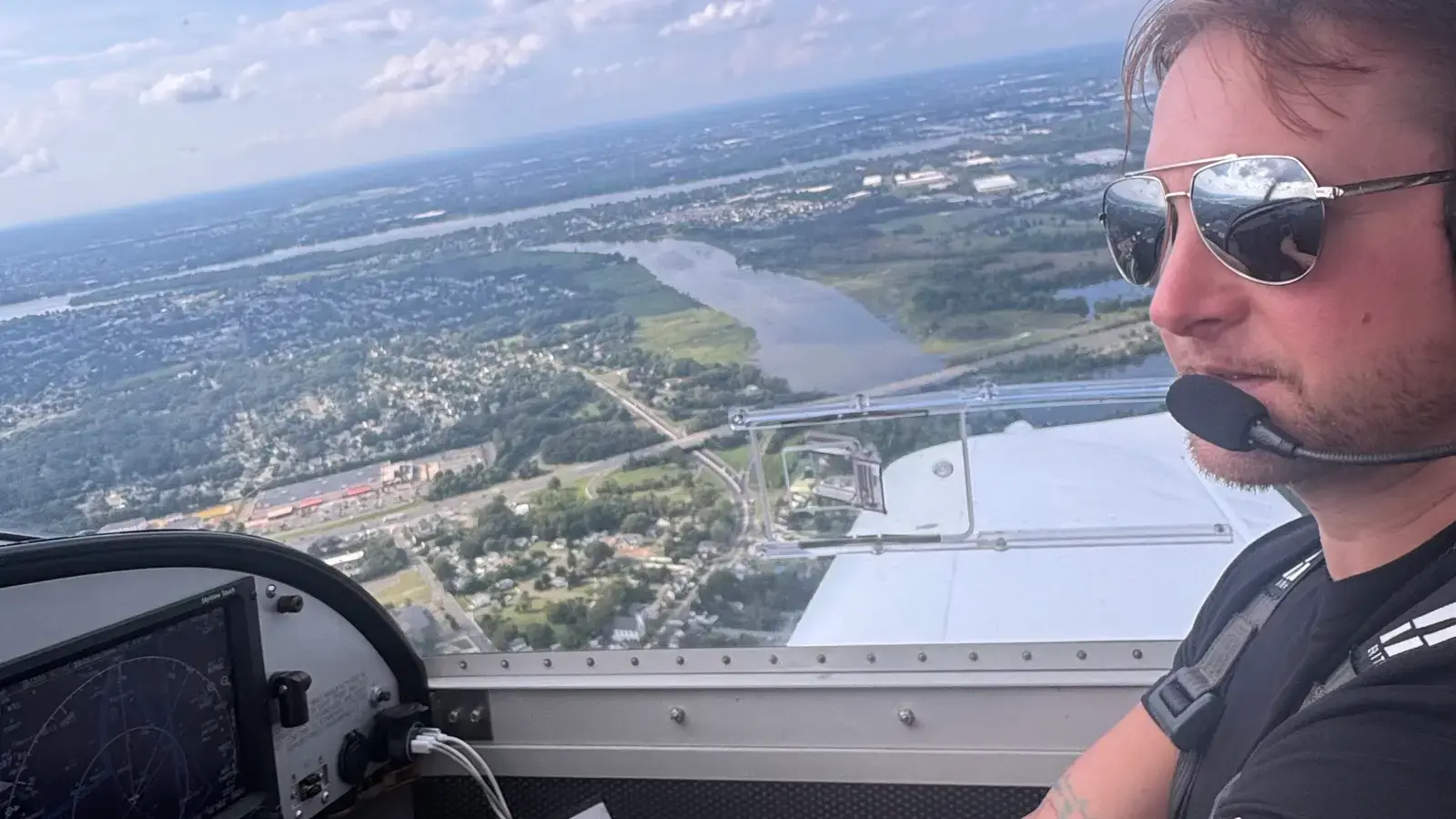
With a private pilot certificate, you can fly an airplane as pilot in command, carry passengers, fly at night and land at public airports across the United States in visual weather. You can't fly for compensation or hire (14 CFR 61.113), and you have to stay current to keep using it.
"Private pilot license" is the everyday name. The FAA calls it a private pilot certificate. This guide covers the privileges and limits for the airplane single-engine land certificate, which is what most people train for, with the rule behind each one. If you want to know how to earn it, start with our private pilot requirements checklist.
What does a private pilot certificate let you do?
| What you want to do | Allowed? | Rule |
|---|---|---|
| Carry passengers | Yes, with 3 takeoffs and landings in the last 90 days | 61.57(a) |
| Carry passengers at night | Yes, with 3 night takeoffs and full-stop landings in the last 90 days | 61.57(b) |
| Split the cost of a flight | Yes, if you pay at least your pro rata share | 61.113(c) |
| Fly in Class B airspace | Yes, with an ATC clearance | 91.131 |
| Fly in clouds or low visibility | Not without an instrument rating | 61.3(e) |
| Get paid to fly | No, with a few narrow exceptions | 61.113(a) |
The certificate itself is issued without an expiration date (14 CFR 61.19(c)). What lapses is your currency: the flight review, your medical and your recent takeoffs and landings.
Can a private pilot carry passengers?
Yes. A student pilot may not act as pilot in command with a passenger on board (14 CFR 61.89). A private pilot may.
14 CFR 61.113 doesn't set a number of passengers for a pilot flying on an FAA medical certificate. The airplane does: its seats and its loading limits.
The condition is recent experience. Under 14 CFR 61.57(a), you may not carry anyone unless you've made at least three takeoffs and three landings in the preceding 90 days, as the sole manipulator of the controls, in the same category and class of aircraft. In a tailwheel airplane, they must be full-stop landings in a tailwheel airplane.
If you've gone past 90 days, the same rule lets you fly alone in day VFR conditions to get the three back.
Can a private pilot fly at night?
Yes. Private pilot training includes at least 3 hours of night flight training, with 10 takeoffs and 10 landings to a full stop and one night cross-country of more than 100 nautical miles total distance (14 CFR 61.109(a)(2)).
To carry passengers at night, you need three takeoffs and three landings to a full stop within the preceding 90 days, made between 1 hour after sunset and 1 hour before sunrise (14 CFR 61.57(b)).
The airplane has to be equipped for it. 14 CFR 91.205(c) lists the equipment for night VFR flight, and 14 CFR 91.209 requires lighted position lights from sunset to sunrise.
Can private pilots get paid?
No. Under 14 CFR 61.113(a), a private pilot may not act as pilot in command of an aircraft carrying passengers or property for compensation or hire, or act as pilot in command for compensation or hire at all.
The same section allows a few things:
- Sharing costs. You may not pay less than your pro rata share of a flight's operating expenses, and the only expenses that count are fuel, oil, airport expenditures and rental fees (61.113(c)). With three passengers, there are four people on board, so you pay at least a quarter.
- Flying for your own work. You may fly in connection with a business or job if the flight is only incidental to it and the airplane carries no passengers or property for compensation or hire (61.113(b)).
- Narrow exceptions. These include charity flights under 14 CFR 91.146, which requires a private pilot to have at least 500 hours, expense reimbursement for sanctioned search and location flights, and glider towing (61.113(d), (e) and (g)).
Cost sharing has two more limits in FAA guidance. Advisory Circular 61-142 says you and your passengers need a common purpose, meaning you have your own reason to make that trip. It also says you can't "hold out," or offer rides to the public.
Flying for pay takes a commercial pilot certificate (14 CFR 61.133). Our private pilot to airline career path lays out those steps.
Can you rent an airplane with a private pilot license?
Yes. You don't need to own an airplane. Flight schools and flying clubs that rent set their own rules, and many ask for a checkout flight with an instructor before you take an airplane alone.
The FAA's part is what your certificate covers. Some airplanes need training and a one-time logbook endorsement first (14 CFR 61.31):
- Complex airplanes
- High-performance airplanes, meaning an engine of more than 200 horsepower
- Tailwheel airplanes
What do you have to do to keep flying?
A flight review every 24 calendar months. It's at least 1 hour of ground training and 1 hour of flight training with an instructor, who then endorses your logbook (14 CFR 61.56). Passing a checkride for a new certificate or rating counts in its place.
A medical certificate, or BasicMed. You need at least a third-class medical (14 CFR 61.23(a)(3)). For private pilot privileges it lasts 60 calendar months if you were under 40 on the exam date, and 24 calendar months if you were 40 or older (61.23(d)). Our third-class medical guide covers the exam.
BasicMed is the alternative. You need a U.S. driver's license, an FAA medical certificate held at some point after July 14, 2006, a physician's exam within the past 48 months and an online medical course within the past 24 calendar months (61.23(c)(3)). It limits you to aircraft authorized for no more than 7 occupants and 12,500 pounds of takeoff weight, with no more than 6 passengers, at or below 18,000 feet and 250 knots indicated airspeed (61.113(i)). See BasicMed vs. a third-class medical.
Your documents. Carry your pilot certificate, a photo ID and, if you fly on one, your medical certificate (14 CFR 61.3).
What does an instrument rating add?
Without an instrument rating, you fly under visual flight rules. In Class C, D and E airspace below 10,000 feet, that means at least 3 statute miles of visibility, and staying 500 feet below, 1,000 feet above and 2,000 feet horizontally from clouds (14 CFR 91.155).
An instrument rating lets you act as pilot in command under instrument flight rules, or in weather below those minimums (14 CFR 61.3(e)). It doesn't let you fly for pay.
It requires 50 hours of cross-country time as pilot in command and 40 hours of actual or simulated instrument time (14 CFR 61.65(d)). Our training airplane, N159G, is VFR only, so the instrument rating is a later step in an airplane equipped for it.
Where could you fly from Northeast Philadelphia?
These are examples of flights a certificated pilot could plan from Northeast Philadelphia Airport (KPNE). They aren't trips we sell. All eight are public-use airports. The tower and runway details come from FAA airport data effective October 29, 2026, and the distances are straight lines from KPNE, calculated from the coordinates in the same data.
| Airport | Location | Distance from KPNE | Control tower | Longest runway |
|---|---|---|---|---|
| Millville Municipal (KMIV) | Millville, NJ | about 43 nautical miles | No | 6,003 ft |
| Reading Regional (KRDG) | Reading, PA | about 47 nautical miles | Yes | 6,350 ft |
| Lancaster (KLNS) | Lancaster, PA | about 59 nautical miles | Yes | 6,933 ft |
| Cape May County (KWWD) | Wildwood, NJ | about 65 nautical miles | No | 5,252 ft |
| Pocono Mountains Regional (KMPO) | Mount Pocono, PA | about 66 nautical miles | No | 5,001 ft |
| Easton/Newnam Field (KESN) | Easton, MD | about 91 nautical miles | Yes | 5,500 ft |
| Ocean City Municipal (KOXB) | Ocean City, MD | about 106 nautical miles | No | 4,074 ft |
| Williamsport Regional (KIPT) | Williamsport, PA | about 112 nautical miles | Yes | 6,825 ft |
In an airplane that cruises around 100 knots, 60 nautical miles is about 36 minutes in the air with no wind. Your route will be longer than the straight line.
A few things to plan for:
- Class B airspace. KPNE sits beneath part of Philadelphia's Class B, and flights to the south and southwest pass closest to it. You need a clearance to enter it, or a route and altitude that stay clear of it.
- Easton and the Washington area. Easton is within 60 nautical miles of the Washington, DC VOR/DME. To fly there under VFR, you must first complete the FAA's free Special Awareness Training and hold the completion certificate (14 CFR 91.161).
- Elevation. Pocono Mountains Regional sits at 1,915 feet, against 120 feet at KPNE. Work out takeoff and landing distances for it.
- Cross-country time. A landing more than 50 nautical miles in a straight line from where you started counts as cross-country time toward an instrument rating (14 CFR 61.1). Six of these eight qualify. Millville and Reading don't.
Before any of these flights, 14 CFR 91.103 requires you to know the weather, fuel requirements, alternatives and runway lengths. Check tower hours and notices for each airport too.
Common questions
Does a private pilot license expire? No. It's issued without an expiration date (14 CFR 61.19(c)). To use it, you need a current flight review and a medical or BasicMed, plus recent takeoffs and landings if you carry passengers.
How many passengers can a private pilot carry? 14 CFR 61.113 sets no number for a pilot flying on an FAA medical certificate. The airplane's seats and loading limits decide. Under BasicMed, the limit is six passengers.
Can my passengers pay for the whole flight? No. You must pay at least your pro rata share of the fuel, oil, airport fees and rental (14 CFR 61.113(c)).
Can a private pilot fly in clouds? Not without an instrument rating (14 CFR 61.3(e)). Until then, you stay in visual conditions.
Is a sport pilot certificate the same thing? No. It takes less training and comes with different limits. See sport pilot vs. private pilot.
How does training get you there?
The private pilot certificate takes at least 40 hours of flight time (14 CFR 61.109(a)), plus a knowledge test and a checkride. The solo cross-country flights you make as a student use the same planning as the flights in the table above. Our private pilot timeline shows the order.
Merlin Flight Training is a Part 61 flight school at KPNE. You train one-on-one with an FAA-certificated instructor in N159G, a two-seat Direct Fly Alto.
The usual next step is a discovery flight, an introductory flight lesson where you fly the airplane with an instructor beside you. It's $249, and it's free with a 10-hour block purchase: when you buy your first training block, we credit the $249 back to your account.
Book a discovery flight, or take the free pilot quiz if you're still deciding.
Ready to try it yourself?